
Believes India can grow at 6 - 7 per cent next fiscal.

'We will see a lot of investments from the private sector.' 'As long as we are not impacted by some global events, I think we will be in a strong place.'

India's economy grew 7.8 per cent in the March quarter, pushing up the annual growth rate to 8.2 per cent, according to official data released on Friday. Growth in the January-March period was lower than the 8.6 per cent expansion in the December quarter.

Automobile (auto) retail sales in India grew by an impressive 14 per cent in July compared to the same period last year, driven by a surge in the rural economy, good product availability, and product launches. While passenger vehicles (PVs) saw a 10 per cent increase during this period, inventory levels have surged to a historic high of 67-72 days in PVs, equating to Rs 73,000 crore worth of stock, according to the Federation of Automobile Dealers Associations (Fada). This poses a risk to dealer sustainability. Inventory levels in July 2023 were only 50-55 days, equating to a stock worth Rs 49,833 crore. In June 2024, inventory was between 62 and 67 days, with a stock value of Rs 60,000 crore.

The manufacturing sector, which constitutes 77.63 per cent of the IIP, contracted by 0.4 per cent in March as compared to 5.7 per cent expansion in the year-ago month.

Cheering the rebound in India's economy which grew 5.7 per cent in the April-June quarter, highest in the past two-and-a-half years, India Inc on Friday said it expects the GDP to pick up further on the back of conducive investment policies and execution of reforms by government.

The November IIP has been revised upwards to 3.9% from 3.8%.

Corporate India's struggle with subdued revenue and earnings growth persisted in the October-December quarter of 2024-25 (Q3FY25). The combined net sales (gross interest earnings for lenders) of listed companies grew in single digits for the seventh consecutive quarter, while their combined net profit rose by a single digit for the third straight quarter.

'If you align your ambition with India's rise, the peak of your careers will unfold alongside the peak of India's power.'

Passenger vehicle retail sales in India witnessed a 10 per cent on-year jump in July driven by new model launches and enhanced discounts, industry body FADA said on Monday. Total passenger vehicle retail sales rose to 3,20,129 units in July, as compared to 2,90,564 units in July 2023. "Dealers reported benefits from good product availability, attractive schemes, and a wider range of products," the Federation of Automobile Dealers Associations (FADA) vice president C S Vigneshwar said in a statement.

Geopolitical events, macroeconomic data and quarterly earnings of corporates would guide the stock market in a holiday-shortened week ahead, analysts said. Stock markets will remain closed on Wednesday for Ram Navami. "This week promises to be crucial for the market as fresh worries about a potential conflict between Iran and Israel emerge.

'It can position itself as a China Plus One solution, fulfilling the demands of developed economies.'

Industrial production contracted by 1.9 per cent in November, entering the negative territory after a two-month gap, mainly due to poor showing by manufacturing and mining sectors, official data showed on Tuesday. The manufacturing sector -- which constitutes 77.63 per cent of the index of industrial production (IIP) -- recorded a contraction of 1.7 per cent in November 2020, as per data released by the National Statistical Office (NSO). Mining sector output too witnessed a decline, shrinking 7.3 per cent.

Fada estimates that global supply chain headwinds like scarce availability of rare earth elements for electric vehicle components and geopolitical tensions may affect urban consumer sentiment in June as well.

Production of coal, crude oil, natural gas, refinery products, fertiliser, steel, cement and electricity contracted. The record contraction in the growth rate of eight core sectors will affect the Index of Industrial Production.

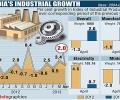
Industrial production growth rate has declined to 7.6%, due to dismal performance by manufacturing, mining and electricity sectors.

Brokerages expect Nifty50 companies to have cumulatively witnessed strong double-digit growth in their earnings in the first quarter of FY24 (Q1FY24). This growth in the combined earnings is expected to have been driven by banks, automakers, and oil & gas companies. Other sectors may report muted profit growth.

The manufacturing sector, which accounts for over 75 per cent of the total weight of the index, grew by just 5.6 per cent in May.

The slowdown has mainly been on account of poor performance by the manufacturing and mining sectors.
The Indian economy will grow by 6.9 per cent in 2011-12 against 8.4 per cent in the last financial year according to government estimates.
Former Finance Minister P Chidambaram on Monday said the high growth that Indian economy has logged in the first quarter of the current fiscal was on account of the UPA policies and the new government must give it the due credit.

India's industrial production growth slipped to five-month low of 1.1 per cent in March from 5.8 per cent in February 2023, mainly due to poor performance of power and manufacturing sectors, according to official data released on Friday. The previous lowest level of growth was recorded in October 2022 at a contraction of 4.1 per cent. The factory output growth measured in terms of the Index of Industrial Production (IIP) stood at 2.2 per cent in March 2022.

Industrial production rose 3.6 per cent in October, mainly due to better performance of manufacturing and electricity generation sectors, official data showed on Friday.

Electricity generation has outperformed the industrial production index for five months in a row this financial year, even as the broader economy is struggling to grow.

State-owned CIL on Monday said coal supply to the power sector rose 15.6 per cent to 49.7 million tonne last month in the wake of high demand of the dry fuel from electricity generating plants and stressed that it is planning to augment its dispatches further, especially to power plants in the coming months. The statement comes at a time when several parts of the country are grappling with power crisis. "With the intense demand for coal continuing unabated driven by an upward spiral in the electricity generation, CIL (Coal India) pushed up its supplies to power plants of the country to 49.7 million tonnes (MT) in April'22.

India's economic growth surged to 20.1 per cent in the April-June quarter of this fiscal, helped by a low base of the year-ago period, despite a devastating second wave of COVID-19. The gross domestic product (GDP) had contracted by 24.4 per cent in the corresponding April-June quarter of 2020-21, according to data released by the National Statistical Office (NSO) on Tuesday. The government had imposed a nationwide lockdown at the onset of the COVID-19 pandemic last year.

India's industrial production contracted by 4 per cent in October, the sharpest fall in 26 months, mainly due to decline in output of manufacturing and subdued performance of mining and power generation sectors, according to official data released on Monday. The Index of Industrial Production (IIP) had grown 4.2 per cent in October 2021. The previous low was (-) 7.1 per cent in August 2020.
Coal India's (CIL's) revenue for the first quarter of 2024-25 (Q1FY25) came in at Rs 36,500 crore, up 1 per cent year-on-year (Y-o-Y) and down 3 per cent sequentially, which was in line with consensus. The blended average selling price was Rs 1,687/tonne, down 5 per cent Y-o-Y and down 1 per cent Q-o-Q, which was below estimates. The adjusted operating profit (excluding overburden removal or OBR costs) stood at Rs 11,500 crore up 3 per cent Y-o-Y and up 17 per cent Q-o-Q, which beat the street. This was due to lower operating expenses.

Finance Minister Arun Jaitley has said the larger interest of the public sector would be fully protected.

Adani group saw a 55 per cent profit surge in the fiscal year ended March 2024 as the apples-to-airport conglomerate is back on an expansion spree and eyeing a $90 billion capex over the next decade. Emerging from a damning report of a US short seller, which hit market value of its listed companies, Adani group in 2023-24 (April 2023 to March 2024) fiscal focused on containing debt, reducing founder share pledge and consolidating business in core competencies.

Taiwan in 1951 came up with an ingenious plan to improve tax compliance: citizens taking receipts for purchases could use them as lottery tickets. Customers were incentivized, and businesses found it hard to evade taxes. The plan's success prompted other countries, Slovakia and Greece among them, to launch similar initiatives. India doesn't seem to find the need yet for such schemes amid surging goods and services tax (GST) collections.

NSO has pegged economic growth at 5 per cent in 2019-20 in its second advance estimates.

'The size of the investments is important, but equally crucial is the number of jobs that these proposals create.'

India's industrial production rose 3.1 per cent in September, according to official data released on Friday. As per the Index of Industrial Production (IIP) data by the National Statistical Office (NSO), the manufacturing sector's output surged 2.7 per cent in September 2021.

On India, the chart showed that the country charged 52 per cent tariffs on the US "including currency manipulation and trade barriers," and America will now charge India "discounted reciprocal tariffs" of 26 per cent.
Vivek Mahajan (Head - Research) Aditya Birla Money, analysed the slow IIP growth.

Enthused by higher than expected GDP numbers in the fourth quarter of 2022-23, Chief Economic Adviser (CEA) V Anantha Nageswaran on Wednesday said India's economic growth may exceed the initial estimate of 6.5 per cent in the current fiscal and the country can look for another year of solid economic performance.

Capital goods, a barometer of investments, showed a sharp increase in output by 14.6 per cent in January, 2018 as against a decline of 0.6 per cent year ago.

The shift to gross calorific value-based grading of coal aligned domestic prices with international benchmarks.

As RBI governor, Sanjay Malhotra will have to give the highest priority to the interest of the economy while deciding on the growth-inflation trade off at Mint Street.
